Many homeowners policies cover tornado and straight-line wind damage. The amount payable depends on the wind/hail terms, the deductible and how the roof is valued. Look for cosmetic-damage wording on metal surfaces and ask what changes if hail impairs the roof’s function.
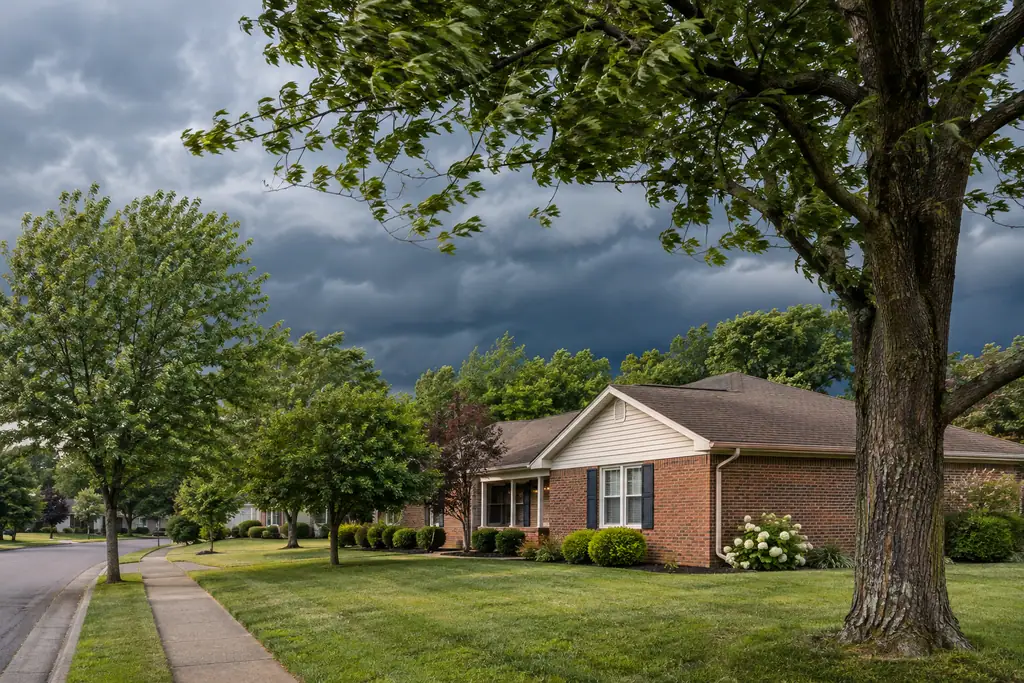
Two wind paths through Murfreesboro
On July 29, 2024, the National Weather Service identified a tornado that traveled through the Middle Tennessee State University area. The same survey mapped a separate, wider swath of damaging wind between the Stones River area and downtown. Surveyors saw uprooted trees, lost shingles and metal lifted on a building. Some structures sustained damage when branches landed on them. Looking only at the narrow tornado track would miss part of what happened to that community.
Williamson County has its own example. The NWS documented a tornado in Franklin during the August 12, 2023 storms. Neither report predicts what will happen on your block. They do explain why the right questions for a quote are about the particular roof, nearby trees, outbuildings and wind deductible. A street address and the age of the house leave out most of that information.
Read the house from the roof edge inward
Start on the ground on a dry day. Photograph each side, including the side facing the open field or parking lot. The eave is the lower edge where a gutter usually hangs. The rake is the sloping edge at a gable end. At both edges, ask a roofer to explain how the roofing starts and how the metal edge was secured. A wind-lifted edge can give rain a way under material that still looks intact farther up the slope.
The roof covering is only the visible layer. Beneath it are the underlayment and the wood deck attached to the framing. When replacing a roof, ask for separate descriptions of deck repair, deck attachment, water protection at the deck and edge details. Photos taken while the old covering is off can answer questions that a finished-roof photo cannot. The Insurance Institute for Business & Home Safety’s FORTIFIED Roof program provides an example of a documented approach. A material brand or a contractor’s invoice alone does not establish a designation.
Walk the perimeter again looking upward at the porch, carport, garage door, soffits and gable vents. A porch roof can have a different installation date and attachment than the main roof. Make a note of what the house actually has. Ask qualified tradespeople about loose components, the garage door’s wind rating and any approved repair, especially when a previous owner added a porch or enclosed a carport.
What hail marks can and cannot tell you
A dented downspout gives an inspector a place to start. It cannot tell you whether every roof slope needs replacement. Wind direction, roof pitch, the exposed side of a skylight and the location of a tree can produce different marks on the same house. Save wide photos showing where the marks are, then closer views from a safe position. Keep the dates and any pre-storm photos. Describe what changed without assigning an exact cause to every mark.
Ask a qualified roofer to distinguish damage affecting shedding water or serviceability from a change in appearance. Have the report identify each slope and component inspected. If a proposal calls for a full replacement, ask what observations support that scope. The insurer applies the contract to the facts. A policy may have a cosmetic-damage limitation for specified surfaces. Ask for the actual wording for metal roofs, metal siding and accessories.
Consider two spots on a standing-seam metal roof after the same hailstorm. One panel has shallow dents but still sheds water. On another, the roofer finds an opened seam that admits rain. A cosmetic-damage exclusion can treat those findings differently because its definition may turn on appearance and function. Ask for a photo and finding for each location. A dent alone cannot establish the claim outcome, and a repair proposal alone cannot establish that every adjacent panel needs replacement.
Tell Your Insure Cure, LLC about this home and when you need coverage.
Get help with my roofRead wind and roof terms together
Put the declarations, roof endorsement and any wind or hail deductible endorsement on the same table. First identify the insured dwelling limit. Then identify what triggers the deductible, whether it is a dollar amount or a percentage, what amount the percentage uses, and whether the roof has a separate settlement provision. An appealing annual premium alone cannot tell you what you would need on repair day.
| Question for the agent | Why it changes your budget |
|---|---|
| Which deductible applies to wind or hail? | Illustration only. A 2% deductible based on a $450,000 dwelling limit is $9,000. It would not be 2% of an $18,000 repair estimate. Use the base stated in your own policy. |
| How are covered roof repairs settled? | Replacement cost, actual cash value and a roof payment schedule can produce different results. Ask about depreciation, repair deadlines and any amount released after repairs. |
| Which parts of the property share these terms? | A barn, detached garage, porch roof or fence may have a different limit or settlement basis. Give the agent the structure’s size, use and material. |
| What if rain comes through the damaged area? | Ask how the form treats interior water following a storm-created opening and which facts the adjuster will need. Surface water entering at grade raises a separate flood question. |
Build a record that survives the storm
Keep a roof invoice showing the address, work date and actual scope. A receipt reading “roof repair” cannot establish that the entire covering was replaced. If the rear addition has an older covering, record its date separately. Keep a digital copy away from the house. Add an inventory of the detached garage and covered patio, especially if a workshop includes business equipment you need the agent to review.
When a warning is issued, take shelter in a basement or an interior room on the lowest floor of a sturdy building, away from windows. If you live in a manufactured home, identify a sturdy shelter ahead of time and be there before the storm arrives. Afterward, stay away from wires, unstable structures and hanging limbs. A rooftop photo is never a condition for making your first call.
When it is safe, contact the insurer promptly and ask how to arrange necessary temporary protection. Photograph each affected room from the doorway, then each visible area of damage. Note when you first saw water. Save emergency-service invoices separately from permanent repair bids. Record the adjuster’s name, claim number and next scheduled contact. If an estimate omits the detached garage or a wet ceiling, identify that item in writing and ask for a review.
An example from quote to repair
Imagine a family comparing two quotes on a brick house with a 12-year-old shingle roof, a newer metal porch and a workshop. One quote lists replacement cost on the dwelling but attaches an actual-cash-value endorsement for roof surfaces. The other uses a percentage wind deductible. Before choosing, the family asks each agent to show how an identical hypothetical covered repair to the main roof would be handled. They request a second explanation for the metal porch and check where the workshop is listed.
The exercise exposes three different decisions. How much cash could the family contribute immediately? How would depreciation affect the final payment? Is the workshop insured for the way they actually use it? Once those answers are in writing, the family can compare terms and annual premiums on a common basis.
Bring to a quote review
- Photograph each elevation and any attached or detached roof from the ground.
- Record full replacement dates separately from patches and partial replacements.
- Convert a percentage wind deductible into dollars using the policy’s stated base.
- Request the roof settlement language and any cosmetic-damage wording.
- Save the shelter plan, claims number, policy and inventory where you can reach them away from home.
Homeowner questions
Can a severe thunderstorm damage my house without a tornado?
Yes. The Murfreesboro survey documented damaging wind outside the tornado track. Photograph the property’s damage and report your observations regardless of the storm label.
Should I tell the agent about the age of a porch roof?
Yes. List the main house, additions and detached structures separately if their ages or materials differ. This gives the agent a chance to check the terms that apply to each.
Does an impact-resistant shingle guarantee a discount or a full claim payment?
No. The rating describes performance in a defined test. Ask the insurer what evidence it requires for any available credit and how the issued roof endorsement settles damage.
Does hail denting a metal roof always count as cosmetic damage?
No. The policy defines cosmetic damage, and a qualified inspection can document impaired function, such as a damaged seam that lets water through. Ask which materials and causes the exclusion names.
Sources & local resources
- NWS Nashville · Murfreesboro tornado and damaging winds, July 2024
- NWS Nashville · Franklin tornado, August 2023
- IBHS · FORTIFIED Roof construction details
- Tennessee Department of Commerce and Insurance · Actual cash value and replacement cost
- CDC · Where to take shelter during a tornado
- Tennessee Department of Commerce and Insurance · Claims and contractor guidance
- U.S. District Court, Western District of Tennessee · Example of policy-specific cosmetic damage wording