Tennessee requires qualifying homeowners insurers to make sinkhole-loss coverage available on request. Check whether your policy includes it and what structural damage qualifies. A depression in the yard warrants investigation before anyone can say what caused it.
Why this is a Middle Tennessee question
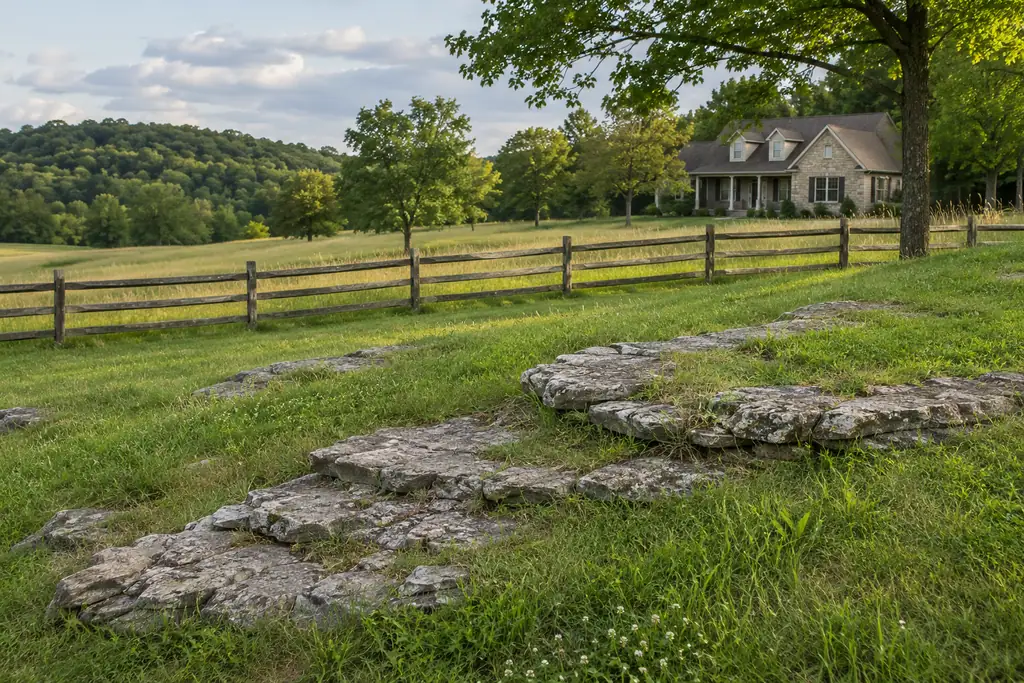
Murfreesboro sits in Tennessee’s Inner Central Basin. The city describes an underground network of water, cracks, caves and other features formed as water dissolves limestone. Geologists call this sort of terrain karst. Rain can feed a spring, disappear underground or collect in a closed depression. The visible creek and the ground surface tell only part of the drainage story.
Karst is a reason to ask about site history. It does not predict that a particular house will move. Two homes on the same stretch of road can sit over different rock, soil and fill conditions. A geological map helps explain the regional setting. It cannot certify what supports a particular footing. For a house with repaired foundation damage or a known depression nearby, the site-specific engineering records are the more useful starting point.
A dip in the lawn is an observation
Suppose an owner notices a dip behind the garage after several wet days. Several questions can be answered before anyone chooses a cause. Is it in an old utility trench? Is there a leaking line nearby? Was there a filled area on the plat or an earlier home inspection? Have doors inside the garage begun to bind? Has the edge of the depression moved? These details help a qualified professional decide what to inspect. A plumbing leak, settling fill, surface erosion and a naturally formed sinkhole can require different responses.
Keep people, pets and vehicles away from the depression. Do not enter it, probe the edge or dump fill into it. If a sinkhole opens under or near the building, Tennessee emergency guidance says to leave the structure. Call 911 if there is immediate danger and notify the utility if a line may be affected. A geologist experienced in karst and an engineer experienced in foundation or sinkhole work can advise about the ground and the structure. Photographs can be taken later from a stable location.
What Tennessee requires insurers to make available
Tennessee Code § 56-7-130 requires insurers offering homeowner property insurance in the state to make insurable sinkhole loss coverage available for optional purchase when a policyholder asks. Ask to see whether it already appears on your policy or whether you need an endorsement or another arrangement. An insurer may inspect the property and charge additional premium. The state insurance department says the opportunity to request coverage extends beyond the start of the policy.
A useful written request is, “Please show me the sinkhole coverage available for this address, the form that provides it, the structures it covers, the deductible, and when it can take effect.” List a detached shop, pool house or other building you want reviewed. The state’s guidance includes structures and contents to the extent covered by the policy. Find out which buildings and property your contract actually insures.
If there is already cracking or a known depression, describe it when requesting the quote. Ask what inspection or documentation the company needs. A new policy or endorsement should never be presented as the solution to an existing loss. Keep the issued forms and effective date with your records, especially if you requested the option during the policy term.
Tell Your Insure Cure, LLC about this home and when you need coverage.
Review my propertySeparate damage to the structure from work on the land
The statutory coverage centers on a specific sequence. Sinkhole activity must cause a sudden collapse of the supporting earth and qualifying structural damage to a covered structure. The law sets thresholds for floor or primary structural damage tied to performance and safety, or an authority’s prohibition on occupancy because conditions are unsafe. Ordinary cosmetic cracking by itself falls outside that definition. The statute excludes stabilizing the land itself. Building stabilization or foundation repairs following a verified covered loss are addressed separately.
Ask the engineer to distinguish work at the foundation from work that alters or stabilizes the surrounding land. If a proposal contains both, ask for separate scopes, drawings and costs. Give the insurer both scopes before authorizing permanent work, and ask which portions are approved. The estimate cannot determine coverage, but a clearly divided estimate makes it easier to obtain a specific answer.
| Observation or proposal | Useful next question |
|---|---|
| A shallow depression sits in a vacant part of the yard. | Where are the nearest structure and buried lines? Arrange an evaluation if it is new or changing. Yard work alone does not meet the statutory structural-loss definition. |
| A drywall joint opened above a door and the door now sticks. | When did it change, and what do earlier pictures show? Ask a professional whether there is foundation movement and what caused it. |
| A covered building has a verified sinkhole loss. | Which engineering plan does the insurer approve? Ask for written instructions on time limits, the contract and how payments for repairs will be handled. |
What to request on an existing or newly built house
On a resale, ask the seller about prior depressions, water or sewer line repairs, foundation leveling, underpinning and previous engineering evaluations. Start with the whole report, including its date, diagrams, recommendations and any limits on the investigation. Then look for invoices, permits when applicable, the final engineer’s letter and any monitoring instructions. A lifetime warranty on one contractor’s materials may tell you very little about a different part of the house.
On a new build, ask the builder which documents apply to your lot and the actual house footprint. A report covering an entire subdivision may include borings on distant lots. Ask whether the report observed fill at the house location, whether a foundation design addressed it, and whether an engineer or inspector documented the work before it was covered. If the house has a detached garage or recent addition, find out whether its foundation was evaluated separately.
For a repaired house, collect the date and cause of the original loss, the contracted scope, proof of completion and written findings since completion. If an engineer recommended monitoring, include results and the planned next check. A buyer or a homeowner facing a difficult renewal can use that file to explain the property’s current condition accurately. An incomplete file is a reason to seek the missing information, not to promise an insurer a repair solved more than the engineer evaluated.
If movement is discovered after purchase
Put safety ahead of inspection. Once you can do so safely, record the date, the first change you noticed, its location, and any immediate utility or emergency action. Keep the original inspection and dated photos available. Contact your insurer promptly with observations and ask for the claim number and instructions for documentation. Document whether someone directed you to vacate and retain that notice. Let qualified professionals explain cause and structural significance.
If the insurer confirms a covered sinkhole loss, obtain the approved engineer’s plan, contracting and completion deadlines, and payment procedure in writing. Tennessee law addresses these steps specifically. A proposal to fill a hole in the lawn is not interchangeable with an insurer-approved foundation repair. Retain the final scope, completion evidence and correspondence after the claim closes. Future buyers and insurers may ask exactly what was done and who verified it.
Bring to a quote review
- Locate the survey, previous engineering reports and drainage plans.
- List all affected buildings, utility lines and observed changes with dates.
- Ask for the sinkhole form, deductible, inspection requirements and effective date.
- Ask the engineer to distinguish foundation work from stabilization of surrounding land.
- Archive completion reports, repair invoices and any ongoing monitoring plan.
Homeowner questions
Does buying homeowners insurance in Tennessee automatically insure sinkholes?
No. Qualifying Tennessee homeowners insurers must make sinkhole-loss coverage available upon request. Check your issued policy and endorsements for the coverage you selected.
Can I use a flood map to rule out a sinkhole at my house?
No. The flood map shows inundation hazard. Regional geology offers context, while a site-specific professional assessment addresses a particular depression or foundation.
What if the seller says there was foundation work but has no paperwork?
Ask for the contractor and engineer names, approximate work dates and permit information. Have an independent professional explain what the available records can establish and what still needs evaluation.
Sources & local resources
- City of Murfreesboro · Geology of the Central Basin
- U.S. Geological Survey · How sinkholes form
- Tennessee Emergency Management · Karst and geologic hazards
- Tennessee Department of Commerce and Insurance · Residential sinkhole coverage bulletin (PDF)
- Tennessee General Assembly · Enacted sinkhole loss and repair legislation
- Tennessee Code § 56-7-130 · Full statute via Justia